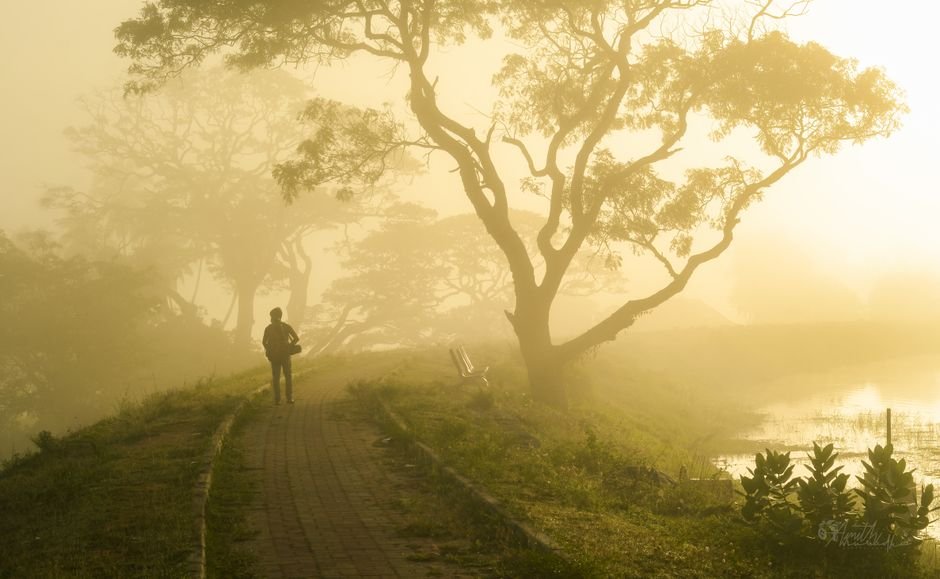
The Park Before the Dog Walkers
The park nearest me has three gates and a circuit of about a mile and a half. On a June morning at half five it is empty. On the same morning at quarter past six there are perhaps twenty people in it, almost all with dogs, and by seven it is a busy public space with runners, commuters cutting through, and the first pushchairs.
The window is real and it is narrow, and in December it barely exists at all.
The window moves and the reason is not the clock
This took me an embarrassingly long time to understand. The park does not fill at a fixed time. It fills relative to sunrise, because the people who use it early are mostly walking dogs and they go when it is light enough to see.
So in June, when the sun is up before five, the park is occupied from half five and the quiet window is over almost before you would want to be out. In late October, sunrise is around eight, and the window runs from about seven to twenty past. The clock time changes by two and a half hours across the year while the relationship to the light barely moves.
Once I started checking sunrise times rather than setting a fixed alarm, this got much easier. The rule I use now is to arrive about twenty minutes before sunrise, which gives enough light to walk and about forty minutes before it fills.
Winter is the exception and the best of it
In December and January the sun comes up so late that the early window collides with people leaving for work, and it stops working as a strategy.
But that same lateness creates something better. Sunrise at eight in a city park means you can watch it on a weekday without getting up early at all, and because it is cold, there is almost nobody there anyway. The dog walkers still come but there are fewer of them and they do not linger.
The best mornings I have had in that park have all been in the first week of January, freezing, half light, and effectively empty, at an hour that required no particular effort to reach.
What changes when it is empty
The main thing is that you can hear the park. The circuit passes a stream that I did not know was audible for the first two years I walked there, because during the day it is under the traffic from the road on the north side.
Mist, if the conditions are right, which in an urban park usually means a still night after a wet day. This is much more common in autumn and it changes the scale of the space completely, closing the sight lines down to thirty metres and hiding the buildings on all sides.
Deer, in parks that have them, and foxes in most parks whether or not anyone realises. I see a fox roughly one morning in four and almost never at any other time.
Sharing it once it fills
The changeover is not unpleasant, which is worth saying because the framing of all this can sound faintly misanthropic.
Early dog walkers are the friendliest population of any public space I know. There is a nod, sometimes a comment about the weather, and no expectation of more. After a few months of the same circuit at the same time you develop a set of nodding acquaintances whose names you will never learn and whose dogs you will.
I would not describe that as an intrusion on solitude. It is closer to the minimum viable amount of society, and having a small amount of it before eight in the morning turns out to be good for the rest of the day.
What to check before you go
Gate times, which catch people out. Many urban parks lock overnight and open at a fixed hour that may be later than sunrise in summer and earlier in winter. If the park has railings, check.
Whether the paths are lit. An unlit path twenty minutes before sunrise is fine in June and genuinely dark in November.
And the ground. Grass at that hour is wet in every season including summer, and boots make the difference between forty pleasant minutes and forty minutes thinking about your feet.
Which part of the park
Most urban parks have a busy half and a neglected half, and the division is usually about distance from the main gate and from the car park.
The neglected half is where to go, and it is often the part with no facilities: no playground, no cafe, no formal planting. In mine it is a stretch of rough grass and scrub along the eastern boundary that the council mows twice a year. It has the most birds, the most foxes, and almost no people at any hour, let alone at six.
The formal areas, the rose garden and the avenue and the bandstand, are lovely and are also where everyone goes. They fill first and empty last.
If the park has water, that is where the dog walkers converge, so it is worth visiting first and leaving before the changeover rather than saving it for the end of the circuit.
Doing the same circuit repeatedly
I walk the same route most times, which sounds dull and turns out to be the opposite.
Walking an unfamiliar route means most of your attention goes on navigation and on the general novelty of the place. Walking a route you know completely frees all of that up, and what you notice instead is what has changed since last time. A tree down. The stream higher. A different bird. The first frost on the same patch of grass that always frosts first.
After a year the circuit stops being a walk and becomes something closer to a way of tracking the year, which is not what I set out to do and is the part I would now miss most if I stopped.