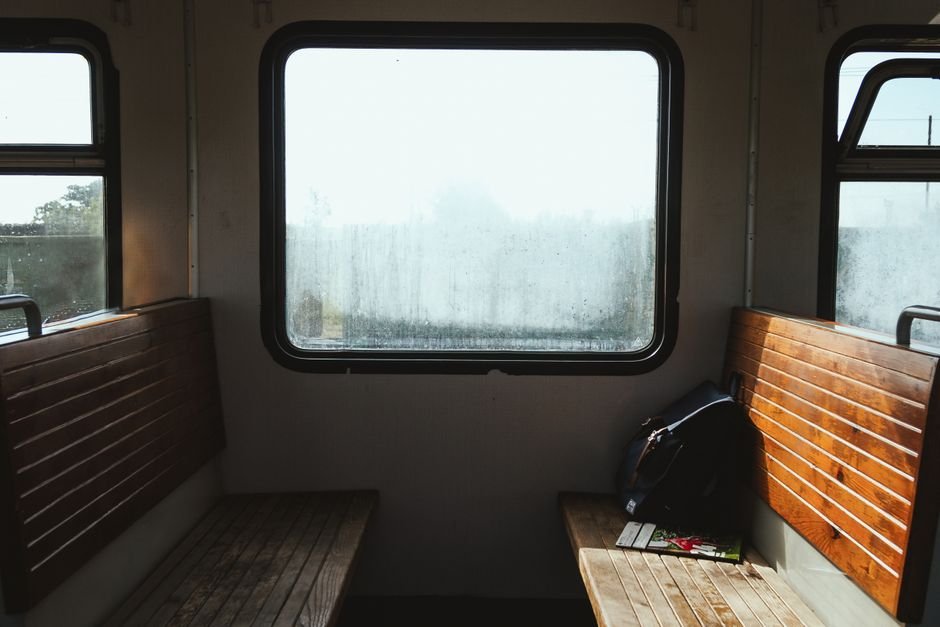
Riding the First Train of the Day
The first train on my line leaves at twenty past five. For the first four or five stops there are perhaps six people in the carriage, and two of them are asleep. By stop nine it is half full. By the terminus it is a normal train.
I have taken it a handful of times with nowhere to go, riding to the end and coming back. That sounds like an odd way to spend a morning and I would have thought so too, but it turns out to be one of the more reliable quiet hours available.
Why it works better than it should
A train carriage is a strange piece of public architecture. It is enclosed, warm, well lit, has comfortable seating, and nobody expects you to justify being in it beyond holding a valid ticket. There is no equivalent room available to the public at half five in the morning.
The near emptiness is the other half. Six people in a carriage designed for eighty means everybody has a bay to themselves and nobody sits near anyone. There is a spatial etiquette that operates automatically and it produces something close to privacy.
And the motion helps, though I cannot defend why. Reading on a moving train has always been easier for me than reading sitting still, and at that hour with nobody talking, it is easier still.
The people who are there
The same categories as the streets at five. Shift workers, mostly. Airport staff on my line, because it goes that way. A few people who have clearly been up all night rather than up early, who are a distinct group and easy to tell apart.
Nobody talks. There is no phone conversation on an early train, which is not true of any other hour. I do not know whether that is because everyone is tired or because the silence establishes itself early and then becomes self enforcing, but it holds consistently.
The one variable is the weekend. A Saturday first train has a completely different population, including people going home from a night out, and it is louder and less pleasant. Weekdays only for this.
Practical arrangements
Check whether your ticket allows a return with no break of journey, because riding to a terminus and coming back may or may not be covered depending on the operator and the fare type. An off peak return to the terminus is usually the simplest and often cheaper than you would guess at that hour.
Sit in the middle of the train. The end carriages are where the staff and the regulars go, for reasons I never established.
The direction matters more than the destination. Going out of the city at five is empty. Coming into the city at five is much busier, because that is the commute for the first shift. If your line is radial, ride outward first.
Toilets on early services are not guaranteed to be working. This is a small thing until it is not.
What I actually get from it
Ninety minutes of reading, uninterrupted, in a warm room, with a window, for the price of an off peak return. When I write it down like that the appeal is fairly obvious.
There is also something about being in motion while doing nothing. I have never been good at sitting still on purpose. A train removes the question of whether I should be doing something else, because there is genuinely nothing else that can be done. That constraint is the point, and it is the same reason people get their best thinking done on long flights.
The obvious objection
It is a slightly absurd thing to do, and taking up a seat on a train you have no need to be on is not costless if the service is busy. On an empty first service it is not taking anything from anyone. On the seven forty it would be indefensible.
I would also say that after about the fourth time it lost most of its novelty and became simply a place to read, which is the correct outcome. The version of this that is a small adventure only works once or twice. The version that is a routine works for a lot longer.
Which lines are best
Not all of them work. The variables are how far out the line goes, how quickly it fills, and whether there is anything to look at.
Suburban lines that run to a commuter town fill fast and the view is mostly the back of housing. Lines that continue out into open country stay empty much longer and give you forty minutes of something worth watching once the light comes. If you have a choice, take the longer one.
Overground and above ground sections matter enormously. A metro line underground at five in the morning is quiet but there is nothing to do except read, which you could do at home. The point of the exercise is partly the window.
Coastal lines, if you have one within reach, are in a different category entirely. The line near me runs along an estuary for about six minutes and at the right time of year that section coincides with sunrise. I have arranged several of these trips around that six minutes.
The return journey is worse
Worth knowing before you plan a round trip. Going out at half five is empty. Coming back at seven is a normal commuter service, standing room in places, and none of the qualities that made the outward leg worth doing.
Two ways round it. Either go far enough out that you have somewhere to be for a couple of hours and come back at ten, when it is quiet again, or accept that the return is just transport and bring something to read that works in a crowd.
I have also, twice, simply got off at the terminus and walked back to a different station, which turned a train trip into a walk and was better than either.