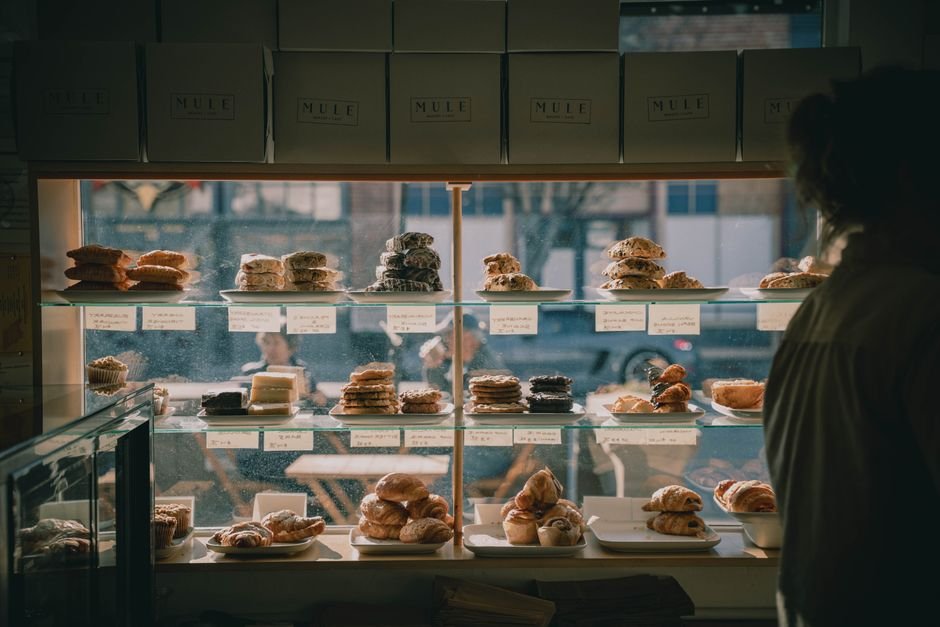
Standing Outside a Bakery Before It Opens
There is a bakery about a fifteen minute walk from me that opens at seven. The bread comes out of the oven somewhere around six thirty, and from about quarter to seven the smell reaches the end of the street.
I stand there. Not every week, but often enough that the woman who opens up recognises me and unlocks the door two or three minutes early if it is cold, which is a small kindness I have never acknowledged out loud in case doing so stops it.
Why standing outside is the good part
The bread is good but it is not, honestly, the point. The point is the twenty minutes before, standing on a pavement with nothing to do, at a time of day when there is nowhere else you could be usefully doing anything.
I have tried to work out what makes this different from just standing on a pavement, which is available at any hour and free. I think it is that there is a defined end. Something is going to happen at seven. Waiting for a specific event that will definitely occur is a completely different experience from having a gap to fill, even though the physical facts are identical.
It is the same reason that waiting for a kettle is restful and waiting for a delayed train is not.
The other people who wait
There are usually two or three. It varies but the same faces recur.
An older man who is always first and never speaks to anyone. A woman with a dog who arrives at about five to and does talk, mostly about the weather, in the specific register of someone who has decided that a queue is a social situation. Occasionally a chef picking up an order, who goes to the side door and is dealt with separately.
The etiquette is loose. There is no formal queue and nobody enforces the order, but everybody knows it and it is honoured. I have never seen it break down. This is a small piece of ordinary civic competence that I find quietly reassuring every time.
What I got wrong
For about a month I brought a book, on the theory that twenty minutes of standing was twenty minutes to read. This was a mistake and it took me longer than it should have to see why.
Standing and reading is uncomfortable, so I read badly. But more than that, having something to do removed the thing that made the twenty minutes valuable. I was no longer waiting. I was reading, slightly awkwardly, in a place I would not have chosen to read. The whole quality of the interval collapsed.
Now I stand there and do nothing, and the doing nothing is the entire content. Twenty minutes turns out to be a long time to do nothing, and the first five of them are usually mildly uncomfortable before something settles.
Making it work where you are
The requirements are narrower than I first thought. It needs to be a walk of at least ten minutes, so that arriving is an arrival. It needs to open at a fixed time that is early enough for the street to be quiet. And it needs to be somewhere you can stand without being in the way.
A supermarket bakery does not work. A place with a queue of thirty does not work either, because then you are managing a queue rather than waiting in one. Two to four people is the range.
Fishmongers, market stalls setting up, and the side doors of hotels where the kitchen takes deliveries all produce a version of the same thing if there is no bakery near you. What matters is a fixed early opening and a short walk.
Whether it survives being written down
I have some doubt about this. A small unexamined habit is a different thing from a practice you have described and explained, and I am aware that describing it risks turning twenty minutes of standing about into a project with rules.
The test is whether I still go when I have not thought about it. So far, yes.
The cost of being recognised
I mentioned that the woman who opens up knows me now. That is pleasant and it is also a slow erosion of the thing I go for.
At the start I was anonymous, one of three people standing on a pavement. Now there is a greeting, and an expectation that I will come on the days I usually come, and a mild awkwardness if I have not been for a few weeks. None of this is a problem. All of it is a small social obligation that did not exist at the beginning.
I do not have a solution and I am not sure one is needed. But it is worth knowing in advance that any repeated appearance in a small place converts into a relationship eventually, and if what you wanted was to be nobody in particular for twenty minutes, that has a shelf life.
What you are actually buying
A loaf, at a price meaningfully higher than a supermarket. I want to be straightforward about that because there is a version of this piece that pretends the economics do not matter.
Twice a month is affordable for me and would not be for everyone. The waiting is free and the bread is not, and if you took the bread out of it the twenty minutes on the pavement would be no different, so there is a real argument that the sensible version of this involves standing outside somewhere and then going home empty handed.
I have not been able to make myself do that. Waiting for something and then not taking it feels wrong in a way I cannot justify but also cannot get past.