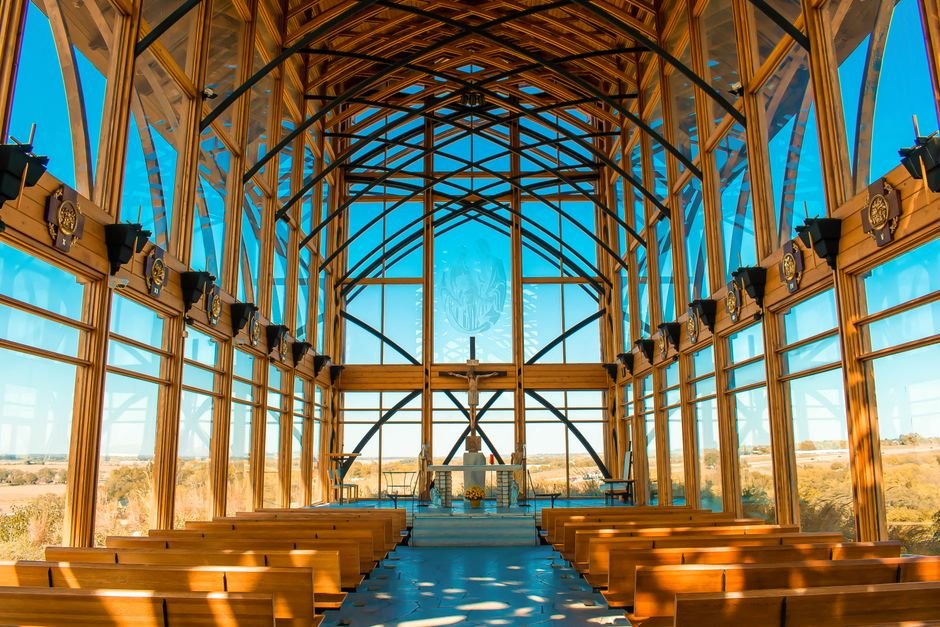
The Chapel in a Building That Is Not a Church
The first time I sat in a hospital chapel I was waiting for news about someone else and there was nowhere else to go. It was a small room off a corridor on the ground floor, six chairs, a window with frosted glass, no imagery of any kind. I stayed about twenty minutes. Nobody came in.
Some months later, not waiting for anything, I went back.
What these rooms are
Most large hospitals, most major airports, many universities and some big railway stations maintain a room variously called a chapel, a prayer room, a quiet room, or a multi faith space. The naming matters less than the design. Because they have to serve people of any religion and of none, the modern ones are usually deliberately neutral: plain walls, a few chairs, sometimes a shelf of texts you can take down if you want them.
They exist because institutions recognise that people inside them sometimes need to sit down away from everyone. That is the entire brief.
On not believing anything
I was uncomfortable with this for a while, and I think that discomfort is worth naming rather than skipping past. It felt like using something not meant for me.
What changed my mind was a sign on the door of one, which said the room was open to anyone who wanted to use it for prayer, reflection, or quiet. Reflection or quiet. That is what the room is for, according to the people who run it. I stopped feeling like a trespasser after reading that.
Where there is any doubt, the chaplaincy office is usually nearby and the people in it are, in my experience, entirely used to being asked.
The etiquette that does apply
Phone off, not silent. This is the one rule I would treat as absolute. Someone may be in there having the worst hour of their life.
Do not eat. Do not work. I have seen someone with a laptop open in a hospital chapel and it was jarring in a way I did not expect, given that I would not have minded at all in a library.
Leave if someone comes in who clearly needs the room more than you do. In a hospital this is not hypothetical. It has happened to me twice and both times leaving was obviously the right thing.
Which ones are worth using
Airport prayer rooms are the least reliable. They are often past security, small, and busier than you would think.
Hospital chapels are the quietest and the most consistently empty, but the surrounding context is heavy and that comes with you into the room. I would not go to one to read a book.
University multi faith rooms are the easiest to use without any of that weight. Between terms they are effectively private rooms that the institution keeps heated and unlocked.
How to find one
They are almost never signposted from outside the building. In a hospital, ask at the main reception or look for a directory board, where it will be listed under chaplaincy or spiritual care rather than chapel. In a university, the chaplaincy is usually attached to a specific building and its location is on the website under student services.
Railway stations vary hugely. Some of the large termini have one, usually tucked away at the end of a platform or on an upper level, and they are among the strangest and most effective quiet spaces I have found, because the noise outside makes the silence inside feel almost physical.
Airports list them on the terminal map, though as noted these are the least reliable in practice.
The weight question
I said above that a hospital chapel brings the surrounding context in with you, and I want to expand on that because it is the main reason I use these less than their emptiness would suggest.
You cannot sit in a hospital chapel without being aware of why the room exists. There is often a book of remembrance, and people write in it. Reading a page of that is not a neutral experience and it is not what you came for, but you will read it, because it is there and you are sitting in silence with nothing else to look at.
I have come to think of these rooms as somewhere to go when the weight is already with you and you need somewhere to put it down, rather than somewhere to go for pleasant emptiness. For the second thing, a university multi faith room does the same job without the freight.
A note on prayer rooms specifically
Where a space is named a prayer room rather than a quiet room or multi faith space, it may be in active regular use at fixed times, and turning up in the middle of that as a spectator is genuinely intrusive.
The distinction is usually visible in the room itself. Washing facilities outside, shoe racks, a directional marker on the wall: these signal a space with a specific and scheduled purpose. A room with six chairs and nothing else does not. When in doubt the chaplaincy office will tell you, and asking is much better than guessing.
Actual churches, briefly
It would be strange to write all this without mentioning that many ordinary churches are open during the day and almost entirely empty, and that most of them have a stated welcome for anyone who wants to sit.
The reason I have not led with them is that the neutrality is different. A working church is full of imagery and text making specific claims, and for some people sitting inside one is not restful for exactly that reason. The purpose built quiet rooms are stripped of that on purpose.
But if it does not trouble you, a large parish church on a weekday afternoon is one of the best quiet spaces in any old city, and unlike everything else on this list it usually has no closing time until evening. Look for a sign saying the church is open for private prayer, which in practice means open for sitting.