The Churchyard, Not the Church
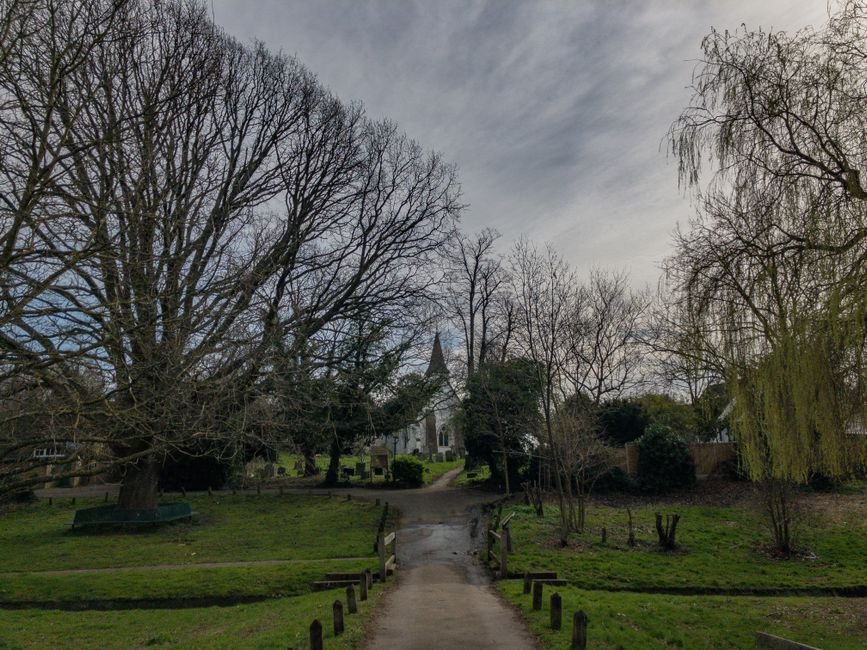
There is a church in the middle of the busiest shopping street in this city. I have never been inside it. Round the back there is a walled churchyard about thirty metres square with four benches, six plane trees, and a gate that stands open.
On a Saturday afternoon, with several thousand people on the street forty metres away, there were two of us in it.
Why they stay empty
Mostly the same hesitation that keeps people out of cemeteries, plus an assumption that the churchyard belongs to the church in a way that requires permission.
In practice, in most old cities, urban churchyards were designated public open space decades ago, often when the burials stopped. Many are maintained by the council rather than the parish. A significant number have been formally laid out as small public gardens with the headstones moved to the walls, which is the giveaway when you see it.
The other reason is that they are invisible. A churchyard is behind a church, and the church faces the street, so you cannot see the space from anywhere you would normally walk. I have found three in this city by going through a gate to see what was on the other side.
What makes them work
Walls. Almost every one is enclosed on all sides by either the church itself or a boundary wall, often both, and usually more than head height. That does two things: it cuts the noise dramatically, and it means nobody walking past can see you.
A thirty metre square walled garden in the middle of a shopping district is a genuinely remarkable thing to have free access to, and the contrast when you step back out through the gate is almost comic.
The trees are the second thing. Churchyards have not been redeveloped, so the planting tends to be old, and in a dense city these are often the largest trees for several streets in any direction.
The etiquette, which is lighter than you think
Much lighter than a working cemetery, because burials in urban churchyards almost always stopped in the nineteenth century and there is nobody visiting a grave.
Sitting on a bench, reading, eating a sandwich: all normal and all things I have seen others do. Loud music, obviously not. Anything that looks like a gathering, probably not, though I have seen small groups having lunch without any apparent problem.
The one live consideration is a service or a funeral, which for a city centre church can be at almost any time on a weekday. If people are arriving in numbers at the front, use a different gate or come back later.
How to find them
Walk round the back of any old church in a dense part of the city. That is genuinely the method. The gate is often on a side street rather than the main road, and it is often not obvious that it leads anywhere.
On a map, look for a church surrounded by a green shape rather than by buildings. Where a churchyard has been converted into a public garden it usually has a separate name, something like St Mary Gardens, which is searchable in a way that the church itself is not.
The best ones I have found are attached to churches that are locked and disused. No services, no congregation, no reason for anyone to be there, and the churchyard still maintained by the council. There is one of these near the station that I would describe as the single best quiet space in the city, and I am not going to name it.
The best time of day
Mid morning on a weekday, and the reason is specific. City centre churches have a lunchtime pattern: office workers come out at twelve and the churchyard fills with people eating sandwiches until about half one, and it is completely full for that ninety minutes.
Before eleven it is empty. After two it is empty again. Those are the windows.
Late afternoon in winter has a particular quality worth going out of your way for, because the walls hold the last of the light and the space stays bright for a while after the street outside has gone grey. Around half three in December is when I would send someone who wanted to understand why I keep going.
A note on the ones that are locked
Some urban churchyards are gated and locked, usually because of problems with drinking or drug use rather than any objection to people sitting quietly.
These are worth checking rather than writing off. A number are locked overnight and open during the day, and the gate that looks permanently shut on a Sunday evening is open at ten on a Tuesday. Where there is a sign giving parish office hours, it is usually accurate.
Where a churchyard is genuinely closed to the public there is normally a notice saying so. I have only found two of those and both had a clear reason posted.
What I do there
Read, mostly, and eat lunch occasionally. The thing I would not do is work, which I have tried, and which converts a garden into an office in about four minutes.
It is also the best place I know for a phone call you are dreading, which sounds like a contradiction given everything else here. But a walled space where nobody can hear you, in the middle of the city, five minutes from wherever you have to be next, turns out to be exactly right for that. I have made three or four of those calls sitting on the same bench.