Community Gardens You Can Just Walk Into
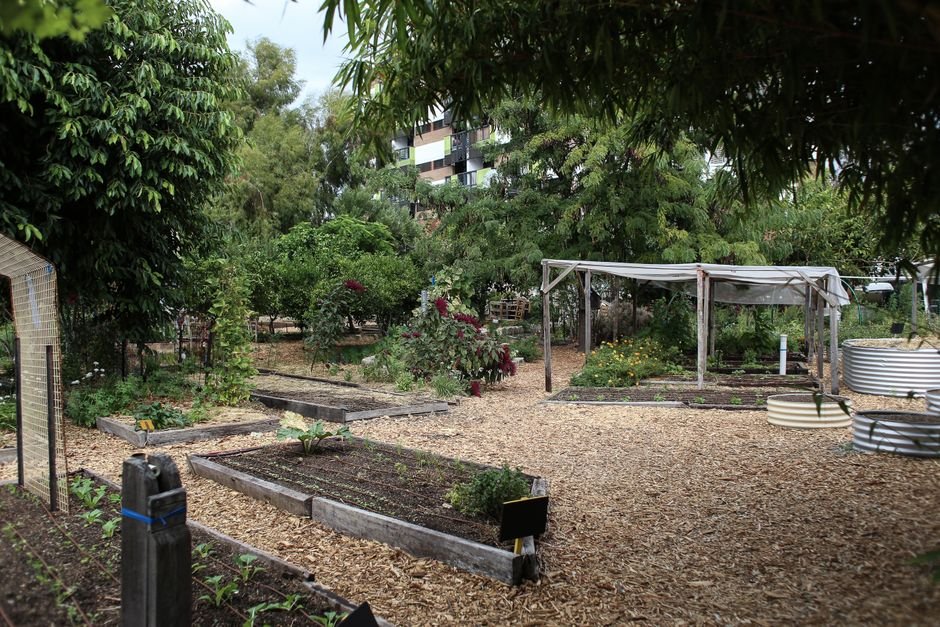
There is a garden behind a row of shops near me that occupies what was a derelict yard until about 2015. It is roughly the size of two tennis courts, has raised beds, a shed, a compost bay, six fruit trees and a bench under a pergola. The gate is unlocked from morning until dusk and there is a sign asking you to close it behind you.
I have sat on that bench perhaps forty times and spoken to another person twice.
Open, members only, and the confusing middle
Community gardens fall into three categories and they look identical from the pavement.
Some are fully public: council owned, unlocked, maintained by a volunteer group, and intended for anyone to use. Some are allotment style, with individual plots rented by members, and walking in is genuinely intrusive. And a large number are somewhere in between, where the space is public but the growing beds belong to specific people.
The signage usually tells you if you read it properly. A sign that says visitors welcome, or gives opening hours, means open. A sign that gives a membership contact and nothing else usually means not. A padlock with a combination means members only regardless of whether the gate happens to be open.
Where there is no sign at all, my rule is that a garden with a bench positioned to look at the garden is meant for sitting in, and a garden with no seating other than a chair by a shed is a workspace. That heuristic has not failed me yet.
What they are like to sit in
Small, which is the point. A community garden is enclosed in a way a park never is, usually by walls or fences or the backs of buildings, and that enclosure does most of the work. Street noise drops noticeably. You cannot be seen from anywhere except inside.
They are also messy in a good way. Nothing is manicured, everything is a bit ad hoc, there is usually a structure someone built out of pallets. It reads as a place people care about rather than a place that gets maintained, and the difference in feel is substantial.
The planting is edible and seasonal, which means the space changes far more across the year than a park does. In February it is bare beds and mud. In July it is over your head.
The obligation question
If you use one regularly, at some point you should probably help.
Most have a work session, typically a couple of hours on a weekend morning, advertised on a board by the gate or on a social media page. Turning up to one of these as a stranger is easier than it sounds and is the standard way people join. Nobody expects you to know anything.
I did this after about six months of sitting on that bench and it was mildly awkward for the first twenty minutes and completely fine after that. It also changed how I use the garden, which was not entirely what I wanted. Now I know people there, and a solitary bench has become a slightly social one.
That is a real trade off and I would not tell anyone which way to make it. But taking the quiet indefinitely without ever contributing sits badly with me, and the gardens exist because a small number of people do a lot of unpaid work.
Finding them
They are badly mapped. Most do not appear on the major mapping services, or appear as an unnamed green rectangle.
What works: search for your city or borough alongside terms like community garden network or growing spaces, which usually turns up an umbrella organisation with a list. Local council parks departments often maintain a register. And walking, which is how I found all but one of the ones I use, because they are almost always behind or between things rather than on a main road.
Look for a gap between buildings with a fence and something green behind it. That is the shape they take.
The seasons of a small garden
A park looks broadly the same in March and September. A community garden does not, and after a couple of years of using one regularly the difference becomes the main reason to keep going back.
February is bare beds, mud, and two people arguing amiably about where the potatoes are going. The space feels twice as large as it does in summer because there is nothing in it above knee height. May is the best month to sit in one, everything growing fast and nothing yet collapsed. By August the paths have narrowed to about a foot wide and you cannot see the far end.
Autumn is when they get scruffy and I like them most. Tomato plants that have given up, someone letting the nasturtiums take over, the compost bay steaming faintly on a cold morning. None of that would be tolerated in a park and it is exactly what makes the space feel human.
The bench problem
Most have exactly one place to sit, and if somebody is in it, that is the visit over.
This is the practical limitation of the whole category and it is worth planning around. I keep three gardens in rotation for this reason, all within about twenty minutes walk, and I check the nearest first. Twice in maybe forty visits I have arrived and turned around.
There is also a version of this where the bench is occupied by someone who wants to talk, which is not a problem exactly, but it does mean the hour becomes something else.